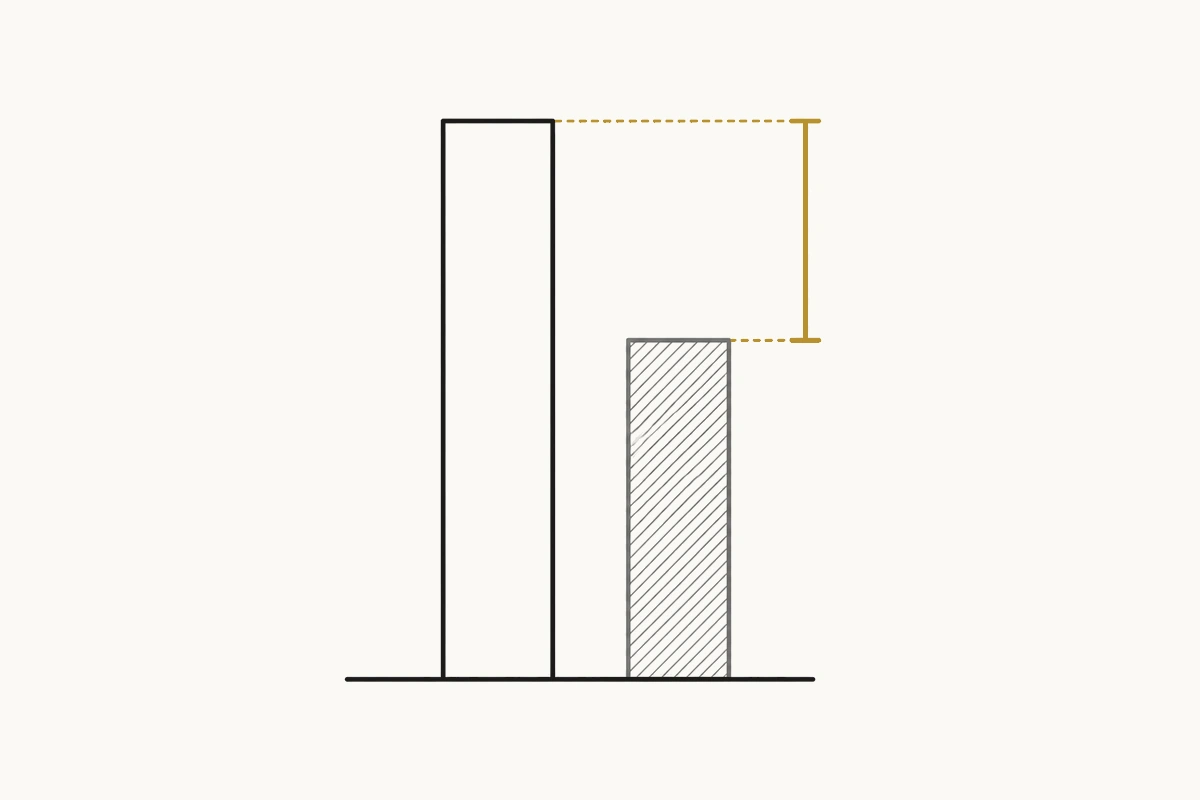
Across my first five months the firm sat just below break-even. Over the nine months that followed it ran at about ten percent net margin.
There was no cost-cutting program in between. Total expenses went up, not down.
That combination confused me for a while, and working out why is probably the most useful thing I learned in the seat. The margin didn't come from spending less. It came from the gap between two growth rates, which is a different lever entirely and one most owners never calculate.
Two numbers
Compare the same two periods. Revenue grew 26.8 percent. Total expenses grew 8.9 percent.
That's the whole mechanism. When revenue grows faster than costs, margin expands, and it expands by roughly the difference between the two rates applied to your existing base. Nobody has to be laid off. Nothing has to be renegotiated. You don't need a single line item to fall.
Most owners think about margin as a subtraction problem: what can come out. It's better understood as a race between two numbers, and you win it either by making the first one faster or the second one slower. Cutting only addresses the second, and costs have a floor while revenue doesn't.
I'd put it more strongly. In a small business the second number is largely fixed by decisions you made a year ago, which is why cost programs feel so exhausting for what they return. You spend a quarter of political capital to move something that was going to move three percent anyway.
The part that complicates it
Underneath that rising total, one bucket fell. Production payroll went down about fifteen percent over the same window.
So this wasn't a business that left everything alone. It was one where a cut happened inside a total that still rose, because what came out of one place went into growth somewhere else. Reallocation, not reduction.
That's the version worth internalizing, because it explains why the top-line expense number is such a bad guide to what's actually happening. A business can be aggressively reshaping its cost base and show a rising expense total. It can also be doing nothing at all and show the same thing. The aggregate tells you almost nothing without the buckets underneath it.
Why the same firm produced a violent loss
The uncomfortable part is that this cuts both ways, and I'd already watched it cut the other way in the same business.
Earlier in my tenure, revenue moved by a factor of only 1.3 across five months while the net margin swung 42 points. A modest revenue wobble produced an enormous margin swing. The cause was the same structural fact that later produced the gain: a cost base that doesn't move much relative to revenue. When revenue drops through that, the loss is disproportionate. When revenue rises through it, so is the profit.
The rigidity never changed. Which side of it we were standing on did.
That's why I'm cautious about presenting the margin improvement as a triumph of management. Some of it was work: pricing, incentives, marketing efficiency, all of which moved the revenue number. But the reason a 26.8 percent revenue increase produced fifteen points of margin, rather than four or five, is that the business had high operating leverage. The same property that had been punishing it.
What to do with this
Two calculations, and you can do both from a year of monthly statements.
Compute your revenue growth rate and your total expense growth rate over the same period. Not the dollars, the rates. The gap between them is your margin change, and once you see it as a gap you'll stop reaching automatically for the lever that only moves one side of it.
Then find out how leveraged you are. Take your worst recent month and your best, and compare how much revenue moved against how much margin moved. If revenue moved thirty percent and margin moved forty points, your cost base is rigid and you're in a business where small revenue changes have violent consequences in both directions.
Knowing that number changes what you should worry about. A high-leverage business doesn't primarily need cost discipline, it needs revenue stability, because the downside months are where the damage concentrates. A low-leverage business is the reverse: it survives revenue dips comfortably and has to grind out margin through cost work, because growth alone won't produce it.
Most owners are running one of these and managing it as though it were the other.
The order
None of this is available to you until the numbers are in front of you, monthly, on a consistent basis. I couldn't see any of it in the annual figures, which showed a business that looked broadly stable and was nothing of the kind. That first step is the whole of the method I use, the TAG method — See the Truth. Implement Actions. Achieve your Goals. Establishing what's true is the part that decides whether the other two are aimed at anything real, and it's the part that gets skipped, because it produces no visible progress and takes weeks.
In this case the truth was that we were not in a cost problem at all. Every month spent looking for one would have been a month not spent on the number that was actually going to move.